

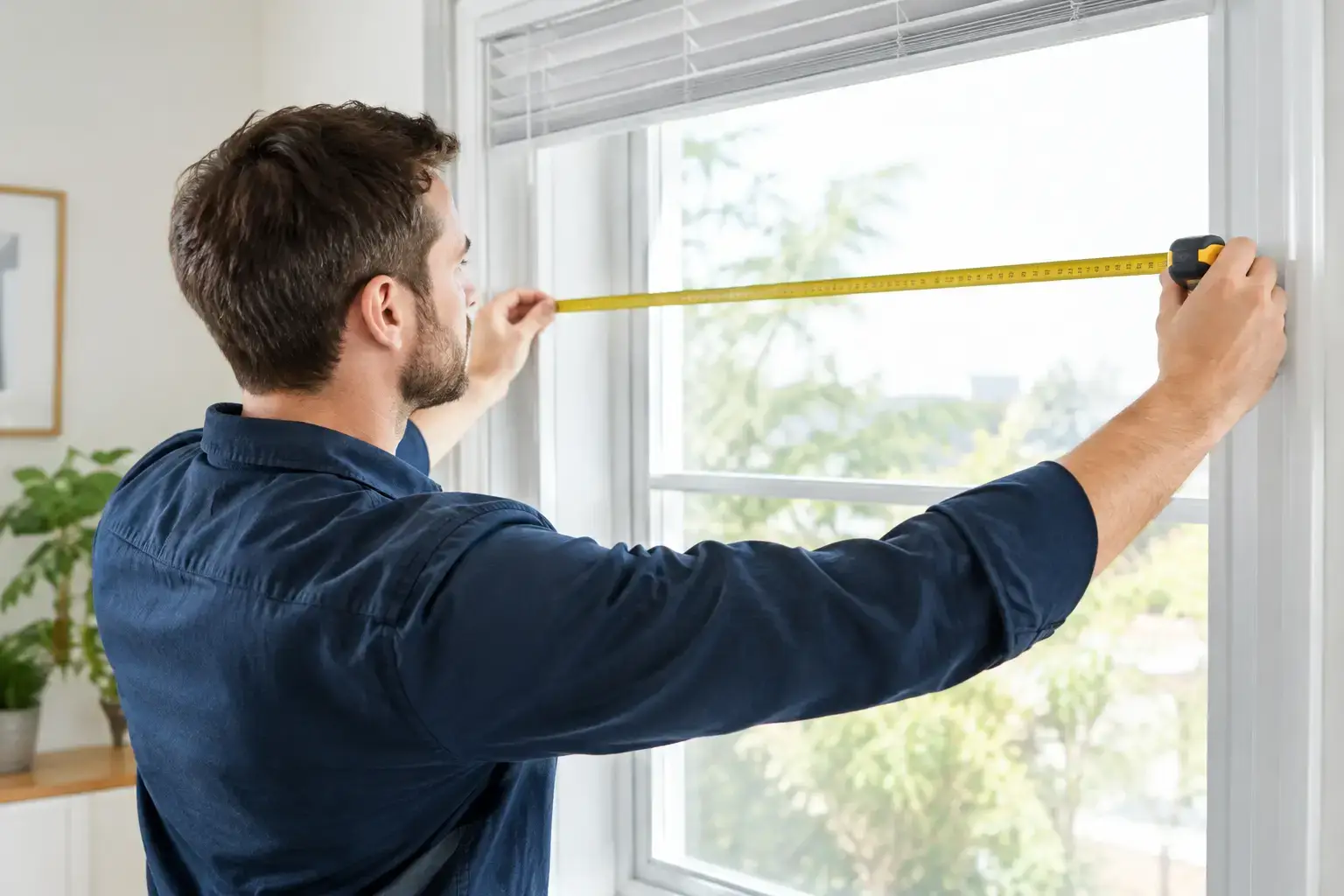
A blind can look premium in the showroom and still disappoint if it is ordered from one rushed measurement. A few millimeters can affect whether the fabric clears a handle, the brackets fit within the recess, or unwanted light shows at the edge. When you measure windows for blinds, the goal is not simply to find width and height. It is to understand the window, its obstructions, and the type of finish you want.
For a clean made-to-measure result, use a steel tape measure, write measurements in millimeters, and measure every window separately. Two windows that look identical in the same room are often slightly different. Avoid using a cloth tape, estimating from a photo, or rounding measurements to the nearest inch.
Decide How Your Blinds Will Be Mounted
Your first decision is whether the blind will sit inside the window recess or outside it. This affects every measurement that follows, as well as the level of light control and the finished appearance.
An inside mount fits within the recess. It creates a neat, built-in look and keeps the blind close to the glass. This option works well for roller blinds, Venetian blinds, Roman blinds, and many sunscreen systems, provided the recess is deep enough and free from obstructions.
An outside mount is fixed on the wall, ceiling, or window frame beyond the recess. It is often the better choice when the recess is shallow, the window opens inward, handles project into the space, or you want stronger blackout performance. By covering more area around the glass, an outside-mounted blind reduces the light gaps that are natural with most inside mounts.
The right choice depends on the room. A living room may benefit from a tidy recess fit that preserves the window architecture, while a bedroom may need an outside-mounted blackout blind for better darkness. During a site visit, an experienced installer will also assess the wall surface, ceiling condition, and suitable fixing points before recommending a system.
How to Measure Windows for Blinds Inside a Recess
For an inside mount, measure the opening itself, not the existing blind or the glass pane. Take the width at the top, middle, and bottom of the recess. Record all three figures and use the narrowest width. Recess walls are rarely perfectly square, especially in older properties or after plastering and painting.
Next, measure the drop on the left, center, and right. Use the shortest height if the blind needs to sit entirely within the recess. This helps prevent the bottom bar from catching where the sill is uneven.
Finally, measure the recess depth. This detail is frequently missed, but it matters. The brackets and blind mechanism need enough clearance, particularly for Venetian, vertical, and motorized blinds. Check for handles, security sensors, vents, tiles, inward-opening shutters, or projecting frames that could interfere with operation.
Do not make your own deductions unless your supplier specifically asks you to. Made-to-measure blind systems have different bracket and fabric allowances. Providing the exact recess size allows the production team to calculate the fitting deductions for the selected product.
Check the Window’s Usable Space
A recess may be wide enough but still unsuitable for a particular blind. For example, a deep Venetian blind can project farther into the opening than a roller blind. A window handle may prevent a full drop, while a split sliding window may require separate blinds for practical access.
If you are choosing a motorized blind, consider where the power supply, charging access, and control system will sit. Battery-operated systems can offer a clean option where wiring is not practical, but the headrail still needs sufficient room and should remain accessible for servicing.
Measuring for Outside-Mounted Blinds
Outside-mounted blinds give you more flexibility because you choose how far the blind extends beyond the window. Start by measuring the full width and height of the area you want covered. Include the intended overlap on both sides, above the window, and below it.
As a general approach, allow enough overlap to cover the glass and frame comfortably. The exact amount depends on available wall space, nearby corners, curtain tracks, AC grilles, light switches, and the kind of blind you select. For blackout roller blinds, greater side overlap generally improves light control. For sunscreen blinds in an office, a more minimal overlap may suit a streamlined façade better.
Measure from the point where the brackets will be fixed to the desired bottom position. If the blind will be ceiling-mounted, measure from the ceiling rather than from the top of the frame. If it will stop at the sill, verify that the sill is level. If it will continue below the sill, make sure furniture, radiators, or built-in units will not block its movement.
Outside mounting also gives more freedom with difficult windows. It can conceal an uneven recess, clear projecting handles, and make a narrow window appear wider. The trade-off is that the blind becomes a more visible design feature, so its fabric color, cassette style, and bracket placement deserve careful consideration.
Measure Each Window, Not Each Room
It is tempting to measure one window in a row of similar windows and assume the rest match. That shortcut often causes the most expensive errors. Construction tolerances, tile lines, window frames, and recess depths can vary from one opening to the next.
Label every measurement clearly. A simple note such as “Bedroom 2, left window, inside mount” is more useful than a page of numbers with no reference. Include width, drop, recess depth where relevant, mounting preference, and notes about handles or obstacles.
For wider glazed areas, decide whether you need one blind or multiple blinds. One large blind can create a clean uninterrupted finish, but it may be heavier to operate and limit access to one section of the window. Two or three coordinated blinds can be easier to control and may suit sliding doors or divided window panels better.
Common Measuring Mistakes to Avoid
The most common mistake is ordering by glass size rather than opening size. The blind must fit the recess or cover the frame, not merely cover the pane. Another frequent issue is measuring only once. Always recheck key dimensions before placing an order, especially when the blind is custom-made.
Be cautious around handles and tilt-and-turn windows. A roller blind may fit the opening but still prevent the window from opening fully. Consider how the blind will operate at different times of day, not only how it looks when lowered.
Also think about adjacent treatments. If curtains are planned with blinds, the curtain track or rod needs to be coordinated before installation. Layered treatments can look refined and improve privacy, insulation, and light control, but they require accurate projection measurements so fabrics do not rub against the blind mechanism.
For commercial spaces, measurements should account for practical use as well. Office sunscreen blinds may need to align across a full glazed wall, while schools and healthcare settings may require flame-retardant, easy-clean, or privacy-focused solutions. Product performance and fixing requirements should guide the measuring process alongside appearance.
When a Professional Measurement Is the Better Option
Self-measurement can work for a simple, accessible window and a straightforward blind. However, a professional survey is the safer option for bay windows, very large openings, motorized systems, blackout installations, shaped windows, or projects involving multiple rooms.
A trained measurer does more than record dimensions. They check the recess condition, identify hidden fitting challenges, assess fabric suitability, confirm control positions, and ensure the blind design works with the way the space is used. This is particularly valuable in Dubai homes where wide glazing, bright sun exposure, and smart-home requirements can influence the best specification.
Dubai Drapes Studio can visit your home, office, or project site with samples, measure each opening precisely, and recommend a blind system suited to your style, privacy needs, and budget. You receive a clear quotation and professional installation instead of relying on assumptions made from a tape measure.
Before ordering, take one final look at how the window opens, where the sun enters, and what needs to happen in the room after the blind is fitted. The best measurement is the one that supports daily comfort as well as a polished finish. Book a Free Appointment to turn your window sizes into blinds that fit as if they were always meant to be there.