

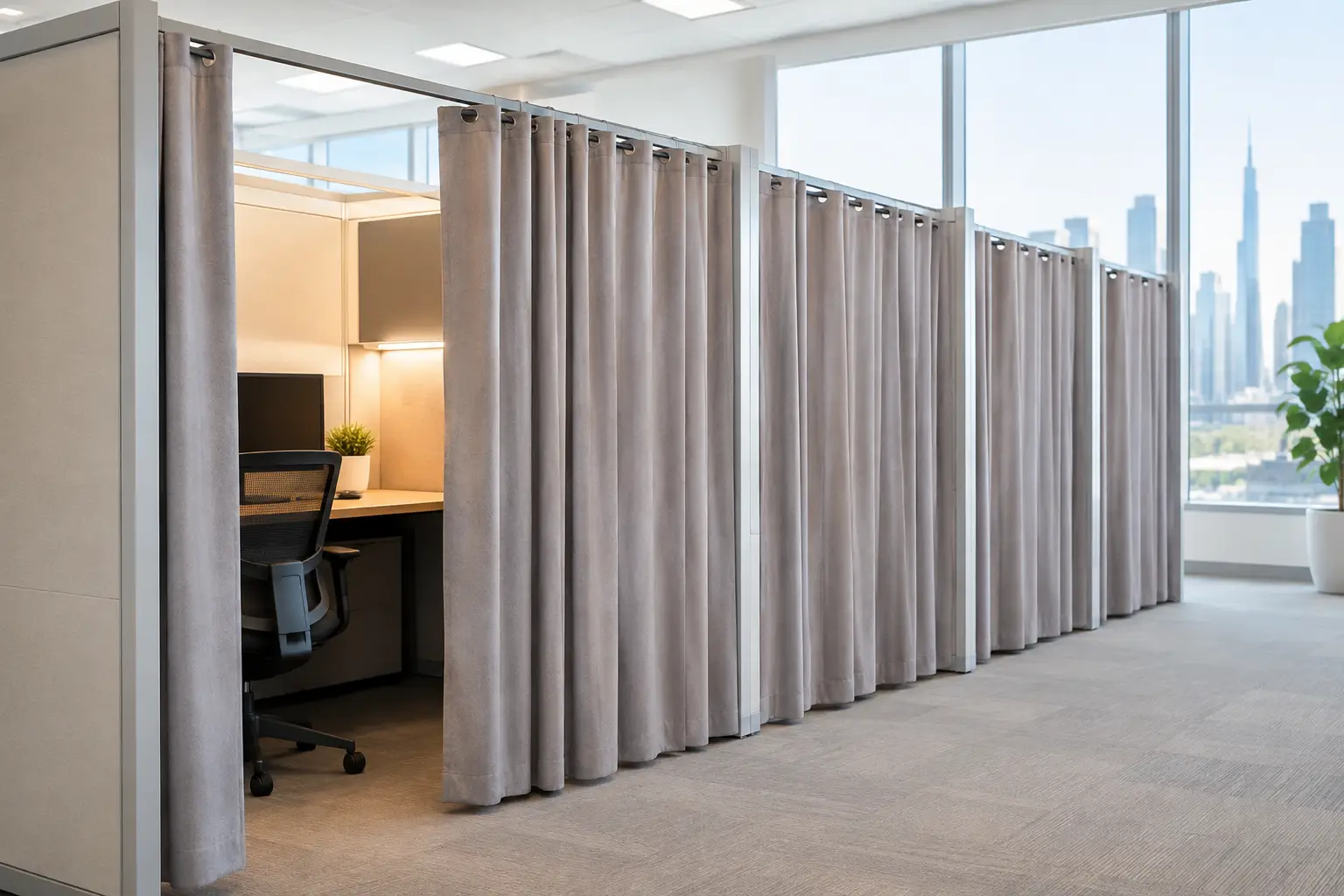
A privacy curtain that is too short, difficult to clean, or constantly catching on its track creates daily frustration for staff and visitors. The right cubicle privacy curtains in UAE do far more than separate a room. They support dignity, hygiene, workflow, and a more polished interior in hospitals, clinics, schools, offices, spas, and care facilities.
At Dubai Drapes Studio, we approach every privacy-curtain project as a practical fit-out requirement, not a standard fabric purchase. That means understanding how the room is used, measuring the ceiling and partition layout correctly, recommending suitable fabric and track systems, and completing installation with a clean, dependable finish.
Why Cubicle Privacy Curtains Matter
Privacy is a basic expectation in any shared environment. In a healthcare setting, curtains give patients a protected space for examinations, recovery, consultations, and personal care. In a school nurse’s room, they help create a discreet area without permanent construction. In salons, changing rooms, therapy centers, and offices, they can divide space quickly while keeping the layout flexible.
Fixed partitions are not always the best answer. They consume floor space, interrupt light flow, and can be costly to alter when room requirements change. Cubicle curtains slide open when space needs to feel connected and close when confidentiality or personal comfort is required. This makes them particularly useful for leased properties, growing clinics, and multi-purpose facilities.
The result depends on the details. Fabric performance, curtain fullness, track placement, drop length, and the number of curtain panels all affect how well the system works day after day.
Choosing Cubicle Privacy Curtains in UAE
The UAE’s climate and the demands of commercial interiors call for materials that are both practical and presentable. A curtain may look attractive at installation, but it also needs to tolerate frequent handling, cleaning, air-conditioning, and the specific requirements of the environment.
Start With the Purpose of the Space
A hospital ward and a boutique spa may both require privacy curtains, but their priorities are different. Healthcare environments often need washable, flame-retardant, antimicrobial, or disposable curtain options based on site policy and infection-control procedures. The fabric should be selected with maintenance schedules and replacement needs in mind.
For offices, education facilities, hotels, and residential care settings, the focus may be on visual softness, acoustic comfort, light control, and coordination with the wider interior palette. Textured neutrals, calming solids, and subtle patterns can help the curtain feel like part of the design rather than a temporary divider.
Discussing the intended use before selecting fabric prevents common mistakes. For example, a lightweight decorative fabric might suit a low-traffic consultation room, while a busy treatment area may need a more durable, easy-care solution.
Get Measurements and Track Layout Right
Cubicle curtains rarely fit a simple straight window-style track. Many installations require L-shaped, U-shaped, curved, or ceiling-suspended tracks that follow the exact bed, treatment bay, or changing-area layout. Even a small measuring error can leave gaps that reduce privacy or cause the curtain to drag on the floor.
Professional measurement considers the ceiling height, soffits, sprinklers, lighting, air-conditioning vents, doors, beds, equipment clearance, and track support points. The goal is to create full visual coverage without obstructing movement or access to essential services.
Track choice matters just as much as fabric choice. A smooth-running aluminum track, correctly supported and fitted with suitable rollers or hooks, makes opening and closing easy. Inferior tracks can sag, stick, or become noisy, particularly in high-use environments.
Select the Right Curtain Construction
The header style determines how the curtain attaches and moves along the track. Mesh tops are often used where air circulation or fire-safety considerations apply, while a full fabric top may suit other commercial or decorative applications. The curtain’s hem and side finishes should also be strong enough to withstand repeated use and laundering.
Curtain fullness is another important consideration. A flat panel can leave visual gaps and look under-finished. Appropriate fullness gives better coverage and a more professional appearance, although it also affects fabric quantity and budget. The best balance depends on the privacy level required and the size of the opening.
Fabric Options for Hygiene, Durability, and Design
There is no single best cubicle curtain fabric for every location. The right option should match the facility’s maintenance process, health and safety standards, design direction, and operating budget.
Washable privacy curtain fabrics are a dependable choice for clinics, schools, care homes, and commercial properties that need a reusable solution. They can be made to size and selected in colors or patterns that complement the interior. Where required, specialized performance fabrics may offer flame-retardant or antimicrobial properties. Always confirm that the chosen material meets the building’s applicable specifications rather than assuming all curtain fabrics provide the same level of protection.
Disposable cubicle curtains can be suitable for facilities that prioritize rapid changeovers and infection-control protocols. They reduce laundering demands, but they also require a clear replacement plan and ongoing supply budget. Reusable curtains can offer more design flexibility and may be more cost-effective over time when a reliable laundry process is in place.
For hospitality, wellness, and premium commercial projects, decorative performance fabrics offer a more elevated finish. The key is selecting a fabric that still performs well under regular use. A beautiful curtain that stains easily or cannot be cleaned according to the property’s needs will quickly become an expensive compromise.
Installation Details That Make a Real Difference
A made-to-measure curtain system should feel effortless once installed. Curtains should glide smoothly, reach the intended coverage points, and hang at a practical height above the floor. Tracks must be securely fixed to suitable ceiling supports, particularly for long runs and curved layouts.
Before installation, a site visit can identify issues that drawings do not always reveal. Ceiling voids, uneven surfaces, sprinkler locations, access panels, and built-in fixtures can change the track design. This is why a physical inspection is especially valuable for active healthcare facilities and renovation projects where existing conditions may differ from the original plan.
Professional installers also make the final adjustments that create a cleaner result. They check that panels overlap correctly, hooks are evenly spaced, tracks operate freely, and no sharp edges or loose fittings remain. These details protect the investment and improve the experience for the people using the space.
A Better Buying Process for Facilities and Fit-Out Teams
For property managers, designers, and project teams, sourcing curtains, tracks, measuring, tailoring, and installation from separate suppliers can create unnecessary delays. A consultation-led service keeps accountability in one place.
Dubai Drapes Studio can arrange a site visit to assess the layout, take precise measurements, present suitable fabric options, and provide a clear quotation before production begins. Our in-house tailoring allows curtain sizes, heading styles, colors, and track requirements to be matched to the project rather than forced into off-the-shelf dimensions.
This is useful for a single treatment bay as well as larger installations across hospitals, clinics, schools, offices, and hospitality spaces. For projects outside Dubai, including Abu Dhabi, Sharjah, Ajman, and other UAE locations, planning the measurement and installation process early helps keep the schedule controlled.
Care and Replacement Planning
Privacy curtains are working furnishings, not install-and-forget items. A clear care routine helps maintain appearance, hygiene, and smooth operation. Staff should know how panels are removed and reattached, which cleaning method is approved for the fabric, and when a curtain should be replaced rather than repaired.
It is also wise to keep a record of the fabric specification, panel sizes, and track configuration. This makes future replacements faster and helps maintain a consistent look if the facility expands or refreshes other areas. For high-use settings, ordering spare panels in the same fabric can prevent a worn or damaged curtain from becoming a visible problem.
The best privacy curtain is one that supports people without demanding attention: it closes smoothly, cleans easily, fits precisely, and belongs in the room. Book a Free Appointment with Dubai Drapes Studio to discuss your layout, view suitable fabric options, and receive a tailored solution that is ready for everyday use.