

A privacy curtain can look like a minor finishing item until it delays a clinic handover, fails a fire-safety review, or becomes difficult for staff to remove and clean. Healthcare curtain compliance UAE projects require more than selecting a fabric color and measuring a bay. The curtain, track, fixing method, labeling, and maintenance plan must work together for the facility’s clinical and operational needs.
For hospitals, clinics, day surgery centers, rehabilitation spaces, and care homes, the right specification protects patient dignity while supporting infection-control routines, fire performance requirements, and reliable daily use. The best result comes from reviewing the room and its intended function before production starts.
Start With the Room, Not the Fabric Sample
A treatment cubicle, emergency department bay, dialysis area, maternity ward, and outpatient consultation room do not have the same privacy or cleaning demands. Before choosing curtain material, establish how the space will be used, who will use it, and how often the curtain will be handled.
In a high-turnover clinical area, staff may need to remove curtains regularly for laundering or replacement. In a consultation room, visual privacy and a quiet, polished appearance may be the main priorities. Areas close to beds, examination couches, or equipment also need carefully planned track positions so the curtain closes fully without obstructing clinical work, doors, ceiling services, or emergency access.
A site survey is where these details become clear. Accurate measurements should include not only the width and drop of the curtain but also ceiling height, soffits, sprinkler positions, lighting, air-conditioning grilles, medical pendants, bed clearance, and the route staff use to enter the bay. A curtain that fits the opening but interferes with essential equipment is not a successful installation.
What Healthcare Curtain Compliance in the UAE Means in Practice
There is no one-size-fits-all curtain specification for every healthcare property. Requirements can depend on the facility type, its location, the authority having jurisdiction, the approved fire strategy, and the client’s own infection-prevention policies. For this reason, project teams should confirm requirements with the facility consultant, fire and life-safety specialist, and relevant approving authority before ordering.
In practical terms, healthcare curtain compliance UAE specifications commonly focus on three areas: fire performance, hygiene and cleanability, and safe installation. The documentation must match the exact product being supplied. A general statement that a fabric is “fire resistant” is not a substitute for appropriate test evidence, product data, or project approval.
Fire Performance Must Be Verified
Cubicle curtains are soft furnishings, but they form part of a healthcare environment where fire safety is taken seriously. Specify inherently flame-resistant or suitably treated fabrics where required by the project brief, and request the relevant certification for the proposed fabric. Make sure the documentation identifies the fabric itself, not merely a similar collection or a prior batch.
There is a trade-off to consider. Some finishes, repeated washing, or inappropriate cleaning chemicals can affect the performance or appearance of certain fabrics. The care instructions should therefore be reviewed alongside fire documentation. If the facility plans frequent laundering, select a product designed to retain its intended performance through the expected maintenance cycle.
Track systems and fixings matter as well. A compliant fabric cannot compensate for loose ceiling supports, poorly planned bends, or a track that prevents rapid access in an emergency. The installation should be coordinated with the ceiling substrate and approved building services layout.
Hygiene Is a Design Requirement
Privacy curtains are touched frequently and can sit close to patients, visitors, and staff. Choose materials that suit the facility’s cleaning protocol, with a surface and construction that can be maintained without excessive shrinkage, fading, or damage. Where the clinical policy calls for removable curtains, a practical hook, carrier, or snap system can make scheduled changeovers far easier for housekeeping teams.
Washability is only one part of the decision. Consider whether the curtain has a privacy mesh at the top, whether that mesh is suitable for the room, and how the heading will be handled during removal. A well-designed curtain system should allow staff to identify, remove, and reinstall panels efficiently without affecting adjacent bays.
For certain settings, disposable or specialized antimicrobial curtain options may be considered. These can be useful, but they are not automatically the best choice for every site. Disposable products create recurring replacement costs, while reusable fabrics require a dependable laundering process. The correct option depends on the facility’s infection-control policy, budget, patient volume, and waste-management approach.
Specify the Full Curtain System
A healthcare curtain is a system, not just a panel of fabric. The specification should state the fabric type, color or pattern, finished drop, fullness, mesh requirement, heading style, track profile, carriers, joins, bends, end stops, and fixing method. Leaving these details open can lead to inconsistent privacy coverage and unexpected site changes.
Fullness deserves particular attention. A curtain that is too flat may leave gaps and feel clinical in the wrong way, while excessive fullness can be heavy, difficult to stack, and more likely to catch on equipment. The right level depends on the fabric weight, track layout, and degree of privacy required.
Color selection also has operational value. Light neutrals can make a small room feel calmer and brighter, while subtle patterns can help conceal minor marks between cleaning cycles. Strong patterns may support wayfinding or a branded interior scheme, but they should not make stains, labels, or staff observations harder to identify. In patient-facing areas, the goal is usually a calm, professional finish rather than a decorative statement.
Plan Tracks Around Real Clinical Movement
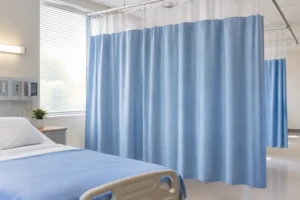
Ceiling-mounted tracks are common in cubicle layouts because they offer better privacy coverage and keep floor areas clear. Straight tracks may suit simple bays, while L-shaped, U-shaped, or curved systems can create privacy around beds, changing areas, and examination zones. Each layout should be checked on site, particularly where ceilings are uneven or services run close to the proposed track line.
The track needs smooth-gliding carriers and a strong, properly spaced fixing arrangement. In retrofit projects, the existing ceiling may not provide suitable support everywhere. This is why a professional survey is preferable to estimating from floor plans alone. It identifies where additional support, revised track routing, or an alternative mounting solution may be required before installation day.
Keep a Clear Compliance and Maintenance File
Facilities managers should receive more than installed curtains. A simple handover file makes future inspections, replacements, and maintenance much easier. For larger healthcare projects, keep the following records together:
- Approved fabric sample and final product reference
- Fire-performance certificates and relevant technical data
- Cleaning, laundering, and replacement guidance
- Track, carrier, and fixing specifications
- Installation layout and completed handover notes
This record is especially helpful when an extension, refurbishment, or replacement order is needed months later. It reduces the risk of mixing unmatched fabrics or substituting a product that does not meet the original project requirements.
Use a Site Visit to Avoid Costly Rework
The lowest initial quotation is not always the lowest project cost. Ready-made curtains can appear economical, but incorrect drops, weak tracks, unsuitable fabric, or missing documentation can create delays and replacement expense. Made-to-measure production gives project managers more control over fit, privacy coverage, and the details required for a professional handover.
Dubai Drapes Studio can visit your healthcare, education, hospitality, or commercial site to measure the space, review curtain and track options, present suitable fabric samples, and provide a clear quotation for custom production and installation. For healthcare environments, involving the installer early helps align the curtain layout with the practical needs of staff and the project team.
Book a free appointment before finalizing your privacy-curtain specification. A curtain system that is easy to clean, properly documented, accurately fitted, and comfortable for patients will keep working long after the room first opens.