
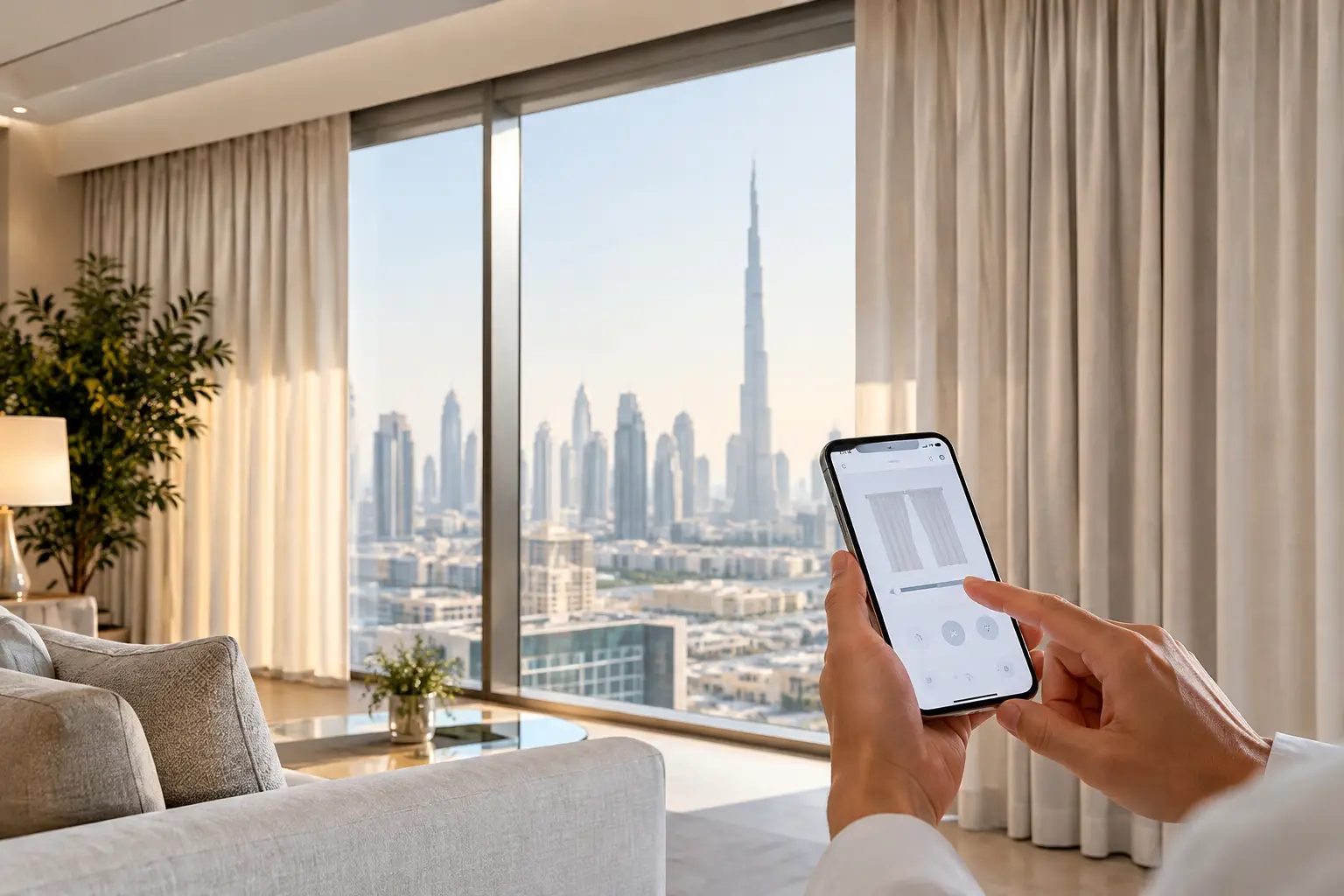
A curtain that closes before the afternoon sun reaches your sofa is more than a convenience. With smart curtains app control, you can manage privacy, glare, and daylight from your phone, whether you are upstairs, at work, or away for the weekend. For villas with wide glazing and apartments where every degree of light matters, app-controlled curtains turn a familiar furnishing into a practical part of the home.
The best results do not come from adding a motor to any existing curtain. They come from matching the fabric, track, motor, power source, and app setup to the room itself. That is why a site visit and accurate measurement matter before choosing a system.
What smart curtains app control actually does
App-controlled curtains use a motorized track connected to a compatible control system. Once installed and configured, the app lets you open, close, stop, and position the curtains from a smartphone or tablet. Depending on the chosen system, you may also create schedules, control groups of curtains together, and connect the treatment to wider home automation routines.
For example, sheer curtains can open at 7:00 a.m. to bring in soft daylight, while blackout curtains in a bedroom can close automatically in the evening. In a living room, curtains can close during the strongest sun hours to reduce glare on screens and help protect furniture, rugs, and flooring from prolonged direct light.
Position control is especially useful when you do not want the curtains fully open or fully closed. A partly drawn curtain can maintain privacy from neighboring buildings while still allowing natural light into the room. This is often more flexible than a standard wall switch, which usually offers only open, close, and stop functions.
Start with the room, not the app
A well-designed smart curtain system should suit how you use the space. The app is the control layer, but the curtain still needs to perform its core job: filter light, create privacy, soften acoustics, and complement the interior.
Bedrooms usually benefit from lined or blackout fabrics, particularly where early daylight or external lighting interrupts sleep. In living rooms, a layered arrangement of sheer curtains with decorative drapes gives more options throughout the day. Sheers can remain closed for daytime privacy, while heavier drapes are available when you need darkness, insulation, or a more formal finish.
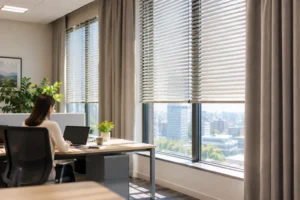
For home offices, consider how sunlight falls on monitors at different times. A motorized curtain can be scheduled around your workday, but the fabric must still control glare effectively. In large villas, tracks may span several meters or cover curved windows, corner glazing, or double-height areas. These situations require a motor with sufficient pulling capacity and a professionally planned track layout.
The same principle applies in hospitality, offices, and meeting spaces. A motorized blackout curtain may be ideal for presentations, while a sheer track can manage daylight without making the room feel closed off.
Choose the right control and power setup
Most customers decide between a battery-powered motor and a hardwired motor. Both can work well, but each suits a different project.
Battery-powered motors are often a practical choice where the room is already finished and running new electrical wiring would be disruptive. They are neat and convenient, although the battery will need recharging at intervals based on curtain weight, usage, and motor model. They work particularly well for moderate-sized windows and retrofit projects.
Hardwired motors are more suitable for frequent use, heavier curtains, large tracks, and new-build or renovation projects where electrical points can be planned in advance. They remove the need to recharge batteries and provide a more permanent solution. If your curtains will operate every day on schedules, hardwiring is usually worth considering during the design stage.
App access may use Wi-Fi directly or a dedicated hub connected to your home network. A hub can be useful in larger homes with several rooms because it supports more stable communication and can allow multiple treatments to work as a coordinated system. Wi-Fi-only options can be simpler for a single room, but the signal strength near the window must be checked.
A professional installation should also include a manual control option, such as a wall switch or remote. Phone control is excellent, but a physical control remains useful for guests, children, and times when your phone is not nearby.
Scheduling that makes daily life easier
The most valuable feature of app control is not the novelty of opening curtains from another room. It is automation that fits your routine.
Morning schedules can gradually open curtains in bedrooms, while evening schedules can close curtains in family rooms before privacy becomes an issue. If you travel regularly, varied opening and closing times can also make an unoccupied home appear more lived in. Avoid relying on identical schedules every day if this is your main goal.
In Dubai and across the UAE, solar heat and glare deserve special attention. A schedule based on the hottest side of the home can help manage intense afternoon light. This does not replace proper glass treatment, air conditioning, or insulation, but it can reduce direct sun exposure and improve comfort in seating areas.
Some systems can work with voice assistants or wider smart-home scenes. A “movie time” scene, for instance, can close the living room drapes while adjusting lights. A “goodnight” scene can close bedroom curtains across the house. Compatibility varies by motor and automation platform, so it should be confirmed before purchase rather than assumed afterward.
Fabric weight, track design, and motor strength matter
Smart operation should feel quiet, smooth, and controlled. If the fabric is too heavy for the selected motor, or if the track has been poorly fitted, the system may move slowly, stop unexpectedly, or place unnecessary strain on the components.
This is why made-to-measure curtains are a stronger choice than adapting ready-made panels. The heading style, fullness, lining, fabric weight, and track width all influence the final load. A double-track setup with sheers and blackout drapes also needs enough clearance for each layer to move freely without catching.
Track placement is equally important. Ceiling-mounted tracks can create a clean, full-height appearance and are often ideal for modern apartments and villas. Wall-mounted tracks may be preferred where ceiling conditions, bulkheads, or decorative details require another approach. In either case, installers should check access for the motor, power connection, and future servicing before final fitting.
Avoid common app-control frustrations
Most problems with smart curtains are preventable. Weak Wi-Fi, an undersized motor, inaccurate measurements, and poor fabric selection are more likely to cause frustration than the app itself.
Before installation, confirm where the router sits and whether the signal reaches the window area. In larger homes, a mesh network or hub may be needed. If the app will be shared with family members, set up access for each user and ensure everyone knows how to use the manual control as well.
It is also wise to think about what happens during a power outage or internet interruption. A quality motorized system should have a practical manual or local-control solution, depending on the model. Ask how the curtains can be operated if the app is temporarily unavailable, especially for bedroom blackout curtains or large doors leading to terraces.
Finally, do not treat automation as separate from interior design. The right motor should disappear into the scheme, while the curtain fabric, heading, and track provide the visual finish. A neat installation is one where the technology is useful without becoming the focal point of the room.
Plan your motorized curtains with an expert visit
For a custom project, the fastest route to a dependable result is to discuss the room, fabric options, track location, and control preference during a site visit. Dubai Drapes Studio can measure the space, bring suitable samples, recommend a motor capacity, and provide a clear quotation for custom production and professional installation.
Bring a few practical details to the appointment: whether power is available near the window, which rooms need blackout or sheer fabrics, whether you want voice or app integration, and how you use each space throughout the day. These answers make it easier to specify a system that feels natural from the first use.
Smart curtains should make your home easier to live in, not add another device that needs attention. Choose a system designed around your windows, your light levels, and your daily routine, and the app becomes a genuinely useful control rather than a feature you forget to use.