
A curtain can look expensive in the showroom and still disappoint at home if the track is wrong. A track that is too short leaves light gaps at the sides, while a poorly supported long track can sag, stick, or pull away from the ceiling. For curtain track installation Dubai homeowners can rely on, the work starts with the window, wall, ceiling, and fabric – not with a standard-length rail.
At Dubai Drapes Studio, we plan made-to-measure tracks around the way each room needs to work. That may mean a discreet ceiling-mounted wave track for a modern apartment, a heavy-duty double track for a villa living room, or a motorized system for tall windows that are difficult to reach. The right result should look considered, open and close smoothly, and remain secure through daily use.
Why Curtain Track Choice Matters
Curtain tracks do more than hold fabric. They determine how wide the curtains can stack, how close they sit to the glass, whether sheers and blackout curtains can operate independently, and how the overall window treatment looks from across the room.
In Dubai homes, light control and privacy are frequent priorities. A properly extended track allows curtains to cover beyond the window frame, reducing side light leakage and creating better privacy at night. In bedrooms, this makes a noticeable difference when paired with blackout lining. In living spaces, a separate sheer track gives daytime privacy without closing the room off from natural light.
The fabric weight also changes the specification. Lightweight sheers can run well on slim tracks, but lined blackout curtains, interlined drapes, and wide decorative panels need stronger carriers, brackets, and fixings. Choosing a track based only on appearance is a common reason curtains become difficult to draw after installation.
What We Assess During a Site Visit
Windows are rarely as straightforward as they appear in a photograph. Ceiling bulkheads, air-conditioning grilles, sprinkler heads, wall returns, furniture placement, and balcony-door clearance can all affect the track position. A free site visit gives the installer a chance to identify these details before production begins.
Measurement is not simply a matter of recording the window width and height. We assess where the curtains should finish, how much space is available for the fabric stack, and whether the track should be face-fixed to a wall or mounted to the ceiling. For floor-length curtains, we also check finished floor levels, rugs, skirting, and any uneven areas that could affect the hemline.
For a double-track system, spacing matters. The sheer curtain needs enough clearance to move freely without catching on the blackout curtain behind it. If the tracks sit too close together, both fabrics can rub, bunch, and lose their neat pleated shape. If they are too far apart, the treatment may project unnecessarily into the room.
A consultation is particularly useful for renovated properties and new builds. Decorative false ceilings may not have suitable reinforcement in every location, and the safest fixing method depends on what sits behind the finished surface. A professional installer checks this before drilling rather than assuming every ceiling can carry the same load.
Curtain Track Installation Dubai: Common Track Options
The best track depends on the curtain style, room layout, and how often the curtains will be used. For most residential projects, one of these options is appropriate:
- Single tracks suit one curtain layer, such as blackout drapes in a bedroom or decorative curtains in a low-privacy space.
- Double tracks are designed for sheers and blackout or decorative curtains, allowing each layer to be operated separately.
- Ceiling-mounted tracks create a clean, full-height look and work especially well with recessed pelmets and contemporary interiors.
- Wall-mounted tracks are practical where ceilings are unsuitable for fixing or when a visible decorative curtain pole is part of the design.
- Motorized tracks offer remote, wall-switch, app, or smart-home control for large, high, or frequently used curtains.
Wave curtains are a popular choice for apartments, villas, hotels, and show homes because they create even, soft folds from end to end. They need a compatible track and correctly calculated fabric fullness. Pencil pleat and pinch pleat curtains can also look excellent, but the carrier spacing and heading style must be matched carefully to avoid irregular gathering.
Curved and shaped tracks are another area where custom fabrication makes a difference. Bay windows, rounded walls, corner glazing, and curved partitions often cannot be treated well with joined straight sections. A purpose-made bent track gives the curtains a continuous run and a neater finish.
The Installation Process, From Measurement to Final Check
A professional fitting should feel organized rather than disruptive. After the consultation, the track type, finish, operation, fabric style, and installation position are confirmed in the quotation. Once approved, the track is cut or fabricated to size and the curtains are tailored to suit the final dimensions.
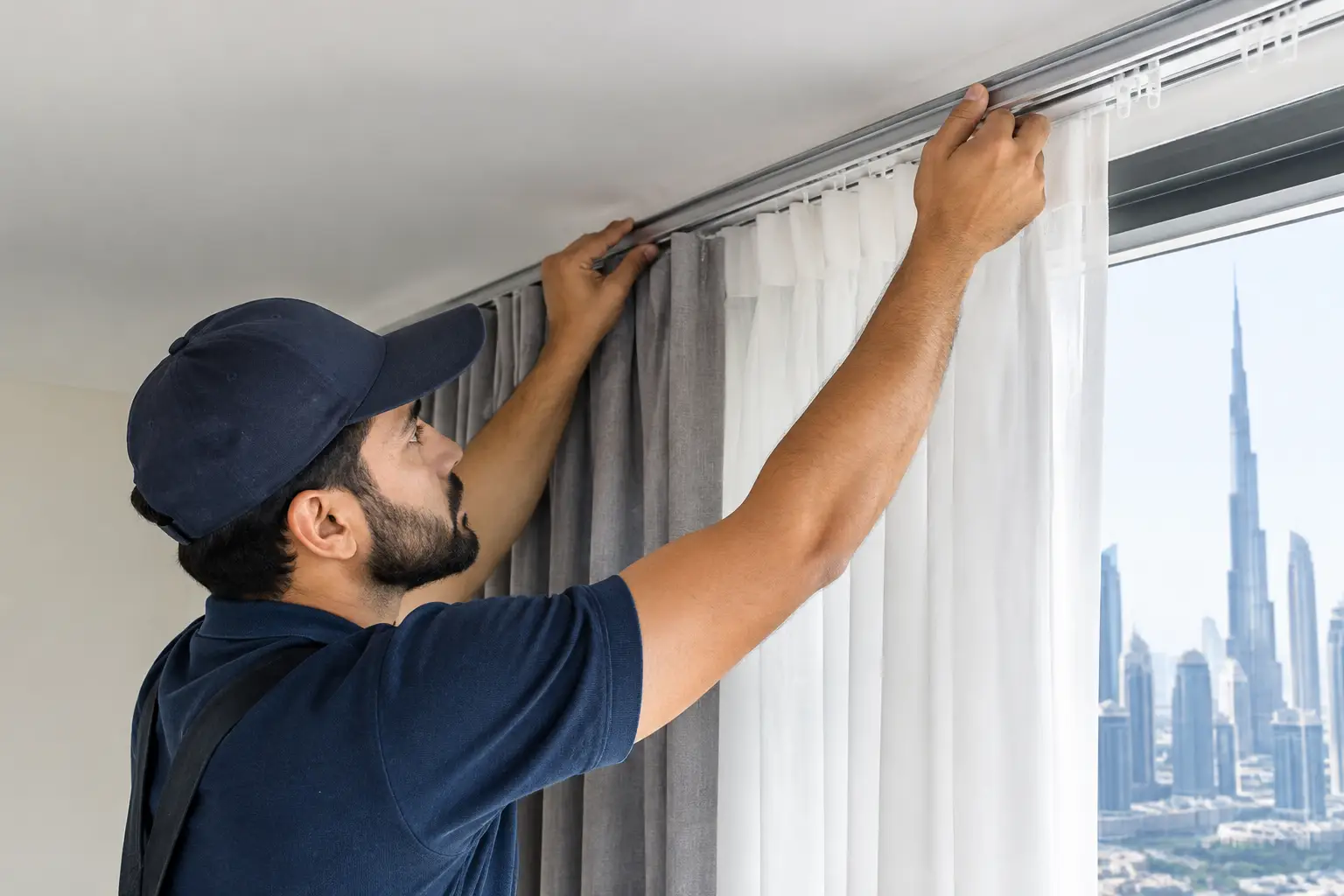
On installation day, the team marks the exact fixing line before drilling. This matters because even a slight variation can be obvious with ceiling-mounted curtains, particularly where the room has a long curtain wall. Brackets are spaced according to the track length and curtain weight, with extra support where needed near joins, bends, and operating points.
The installers then fit the track, carriers, end stops, and curtains before testing the complete system. Curtains should travel without jerking or catching. Center-opening panels should meet evenly, while one-way curtains should stack neatly on the intended side. The final check also includes hem height, side coverage, fabric fullness, and the clearance around doors, furniture, and AC units.
Motorized systems require an additional commissioning step. The motor limits are set so the curtains stop at the correct open and closed positions, and the controls are tested. If the track is being connected to a wider home-automation setup, this should be discussed during the planning stage, especially where power access or concealed wiring is required.
Practical Decisions That Improve the Finished Look
For small rooms, ceiling-mounted tracks can make windows appear taller and walls feel less interrupted. Extending the track wider than the frame allows the curtains to stack mostly off the glass, bringing more daylight into the room when open. This is useful in apartments where every bit of visible window area counts.
For wide villa windows, it may be better to split heavy curtains into multiple panels rather than rely on one oversized panel. The appearance remains generous, but daily operation becomes easier and the track experiences less strain. In rooms with balcony access, consider which side should open most often so the curtain stack does not obstruct the route.
There is also a trade-off between concealment and access. Recessed tracks inside a pelmet or false-ceiling pocket provide a refined, built-in look, but the recess must be wide and deep enough for the chosen curtain layers. A narrow pocket may look clean before installation but leave inadequate space for the curtains to move properly.
When to Choose Motorized Curtain Tracks
Motorization is not only for large luxury properties. It is a practical option for double-height windows, heavy blackout drapes, hard-to-reach tracks behind furniture, and rooms where curtains are opened and closed every day. It can also support better temperature and light management by making it easier to use shading consistently.
However, a motorized track needs correct planning. The motor location, power source, track capacity, and preferred controls should be agreed before fitting. Battery options can suit some situations, but wired systems are often preferable for larger or permanent installations. The best choice depends on the window size, access to electricity, and whether smart-home integration is required.
Book a Free Measurement Appointment
A well-fitted curtain track is easy to overlook because it simply works: the fabric hangs straight, the curtains glide smoothly, and the window treatment supports the room rather than competing with it. If you are fitting new curtains, renovating a home, or specifying window treatments for a commercial project, schedule a free visit to measure the space and review the right track, fabric, and installation approach before ordering.