

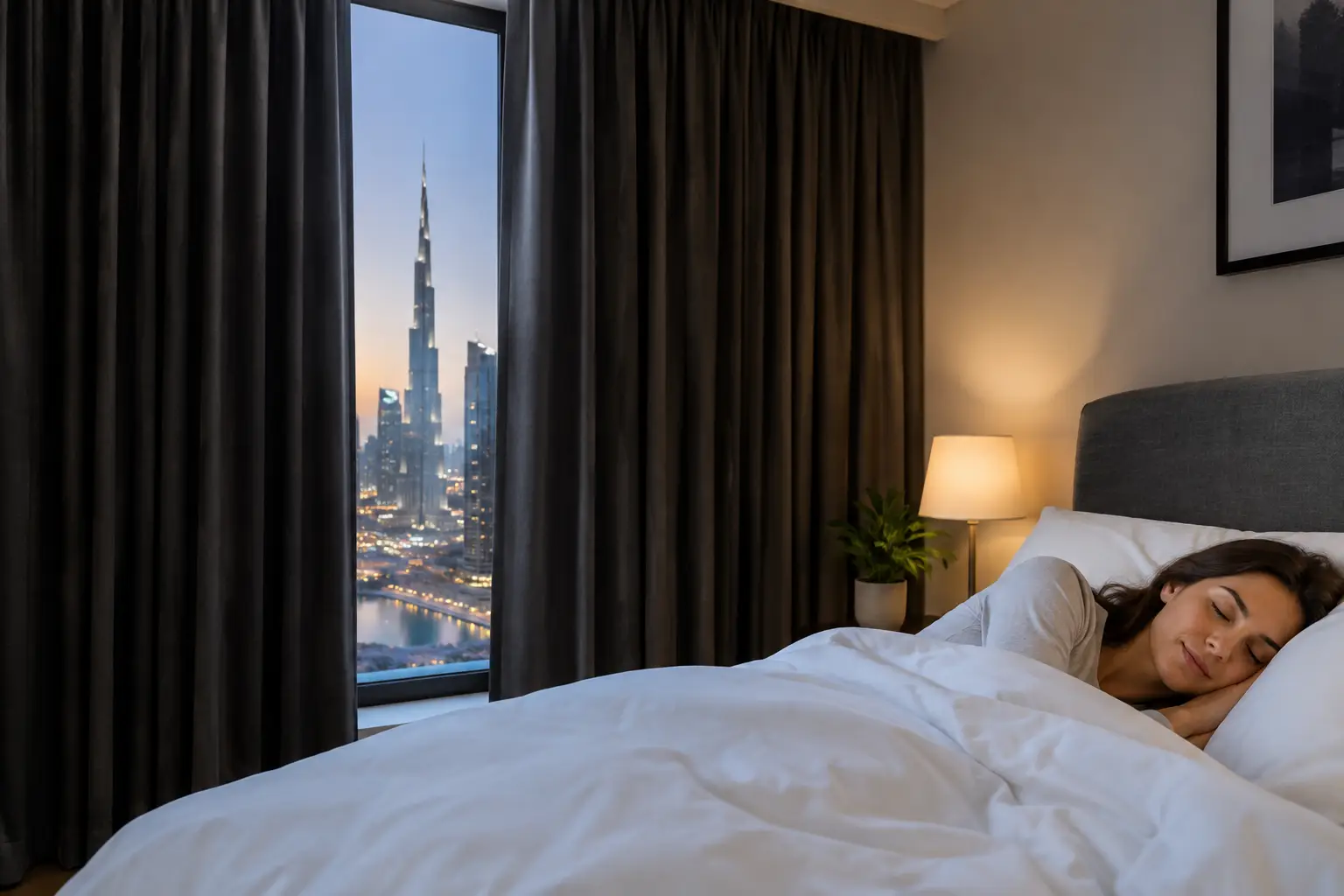
A bedroom facing Dubai’s early morning sun can become bright long before the alarm rings. Add streetlights, neighboring towers, and the heat that builds at the glass, and a standard decorative curtain may not be enough. Blackout curtains in Dubai give homeowners a practical way to control light, improve privacy, and make bedrooms, nurseries, media rooms, and offices more comfortable.
The key is choosing a true blackout solution rather than simply selecting a dark-colored fabric. A deep navy or charcoal curtain can look substantial, but color alone does not stop light. Fabric density, lining, track coverage, side gaps, and installation quality all decide how dark the room will actually feel.
Why blackout curtains work so well in Dubai
Dubai homes often have large windows, glass doors, and open views. These features create attractive interiors, but they also expose rooms to strong daylight and solar heat. In bedrooms, that light can interrupt sleep for shift workers, young children, and anyone who prefers a darker environment. In living areas, it can create screen glare and fade furniture, rugs, and artwork over time.
A properly specified blackout curtain uses either a coated blackout fabric or a decorative face fabric with blackout lining. The curtain blocks incoming light through its material, while a well-fitted track or rod reduces the light that leaks around the top and sides. It also creates a more private interior at night, particularly in apartments where nearby buildings overlook windows.
Thermal comfort is another meaningful benefit. Curtains are not a replacement for quality glazing or air conditioning, but they add an insulating layer at the window. When closed during the hottest part of the day, they can reduce direct solar gain and help rooms feel less exposed to the sun. The result depends on the window orientation, glass type, curtain fabric, and how closely the curtain sits to the window.
What true blackout means
Blackout performance is not always identical from one fabric to another. Some materials block nearly all visible light through the fabric, while others provide room-darkening performance with a softer, lighter finish. Both can be useful, but they should not be sold as the same thing.
For a bedroom that needs maximum darkness, choose a blackout fabric or a curtain with dedicated blackout lining. Pair it with a ceiling-mounted track, allow the curtains to extend beyond the window frame, and make sure the panels have enough fullness. A narrow curtain that barely covers the glass will leave bright vertical gaps, even if the material itself is excellent.
For living rooms and lounges, a layered setup is often the better choice. Sheer curtains can soften daylight and preserve a light, elegant look during the day, while blackout drapes close at night for privacy and glare control. This approach gives the room more flexibility than a single heavy curtain used all day.
It is also worth setting realistic expectations. No fabric panel can create cinema-level darkness if daylight pours around an uncovered top gap, from the sides, or beneath a short hem. Precise measuring and the correct track system matter as much as the fabric selection.
Choosing blackout curtains in Dubai by room
The best choice changes with the purpose of the room. Bedrooms generally need stronger light control and a softer finish that supports rest. A nursery may benefit from blackout lining with a washable, durable face fabric. Home theaters and media rooms benefit from darker tones and wider coverage to reduce screen reflection.
In a villa, floor-to-ceiling windows may require extra-wide custom panels, double tracks, and carefully planned stacking space so the open curtains do not block the view. In an apartment, a compact wave curtain on a ceiling track can provide a clean, tailored appearance without adding visual bulk. For rental properties, a made-to-measure solution can still be worthwhile when privacy, sleeping comfort, and professional presentation affect tenant appeal.
Commercial spaces have different priorities. Hotels may use decorative blackout drapery with sheer curtains for guest comfort. Offices may choose blackout systems in meeting rooms where presentations are affected by glare. Schools and training rooms often need dependable darkness for projection. In every case, the fabric should suit the environment, cleaning requirements, fire-safety needs, and daily use.
Fabric, lining, and color choices
Blackout curtains do not have to look heavy or old-fashioned. The blackout layer can sit behind a textured linen-look fabric, velvet, jacquard, or smooth contemporary weave. This means the room can retain a soft, refined design while gaining effective light control.
Lighter face fabrics can work well in modern Dubai interiors because the lining performs the blackout function. Beige, stone, warm gray, off-white, and muted taupe can make a room feel open during the day, especially when paired with sheers. Darker fabrics may suit a media room or a dramatic bedroom, but they can feel visually heavier in smaller rooms.
The choice between coated blackout fabric and lined drapery depends on the look and use case. Coated fabric is often practical, efficient, and suitable for simple curtains or roller-blind applications. Lined drapery generally offers a fuller, more luxurious finish and gives more freedom with decorative fabrics. It can cost more and take up more stack-back space, so this should be considered during planning.
The installation details that make the difference
Good blackout results begin before production. The installer needs to assess the window recess, ceiling height, air-conditioning vents, furniture placement, door access, and whether the curtain should sit inside or outside the window frame. A curtain that looks correct on a fabric sample can fail in practice if the installation overlooks these details.
For the strongest light control, ceiling-mounted tracks are often preferred because they reduce the gap above the curtain. Extending the track beyond each side of the window helps cover side leakage when the panels are closed. Adding sufficient curtain fullness improves both appearance and coverage, while a properly weighted hem allows the fabric to hang cleanly.
Motorized curtains are particularly useful for tall windows, wide sliding doors, and rooms with several curtain zones. They can be controlled by remote, wall switch, timer, or compatible smart-home system. Automation is convenient, but it should be specified around daily use. A simple manual system may be the more sensible option for a rarely used guest room, while scheduled motorization can be valuable in a sun-exposed master bedroom or living area.
Why made-to-measure is worth considering
Off-the-shelf blackout curtains can be useful as a quick temporary option, but they are rarely designed for the exact width, drop, and track position of a Dubai home. Common problems include hems that stop above the floor, panels that do not overlap, inadequate fullness, and tracks that leave light gaps.
A made-to-measure service addresses these issues through a site visit, accurate measurement, fabric consultation, custom tailoring, and professional fitting. It also lets homeowners coordinate blackout curtains with existing blinds, wallpaper, rugs, bedding, and other finishes. For designers and project managers, this creates a more controlled result across multiple rooms rather than a collection of mismatched window treatments.
At Dubai Drapes Studio, the process is designed around this practical difference. Samples can be reviewed in the actual room, where daylight direction, wall colors, and furnishings are visible. That makes it easier to select a fabric and curtain system that works under real conditions, not just under showroom lighting.
A few buying questions to ask before ordering
Before selecting a fabric, consider when the room receives direct sun, whether complete darkness is necessary, and how the curtains will be operated. Ask whether the quoted product includes blackout lining, track or rod hardware, tailoring, delivery, and installation. If motorization is included, confirm the power arrangement and control method before production begins.
It is also sensible to ask how much space the open curtains will occupy. Large panels need room to stack back, and this can affect window views, balcony doors, and nearby furniture. A professional measurement visit brings these decisions into the open before installation day.
A blackout curtain should do more than darken a room. It should hang beautifully, close smoothly, match the interior, and perform reliably through Dubai’s bright days and busy evenings. Book a free appointment to compare fabrics in your space, discuss the right track or motorized option, and receive a precise quotation for a fitted result.