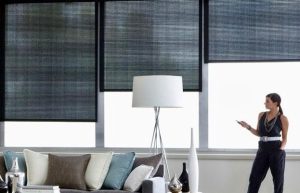

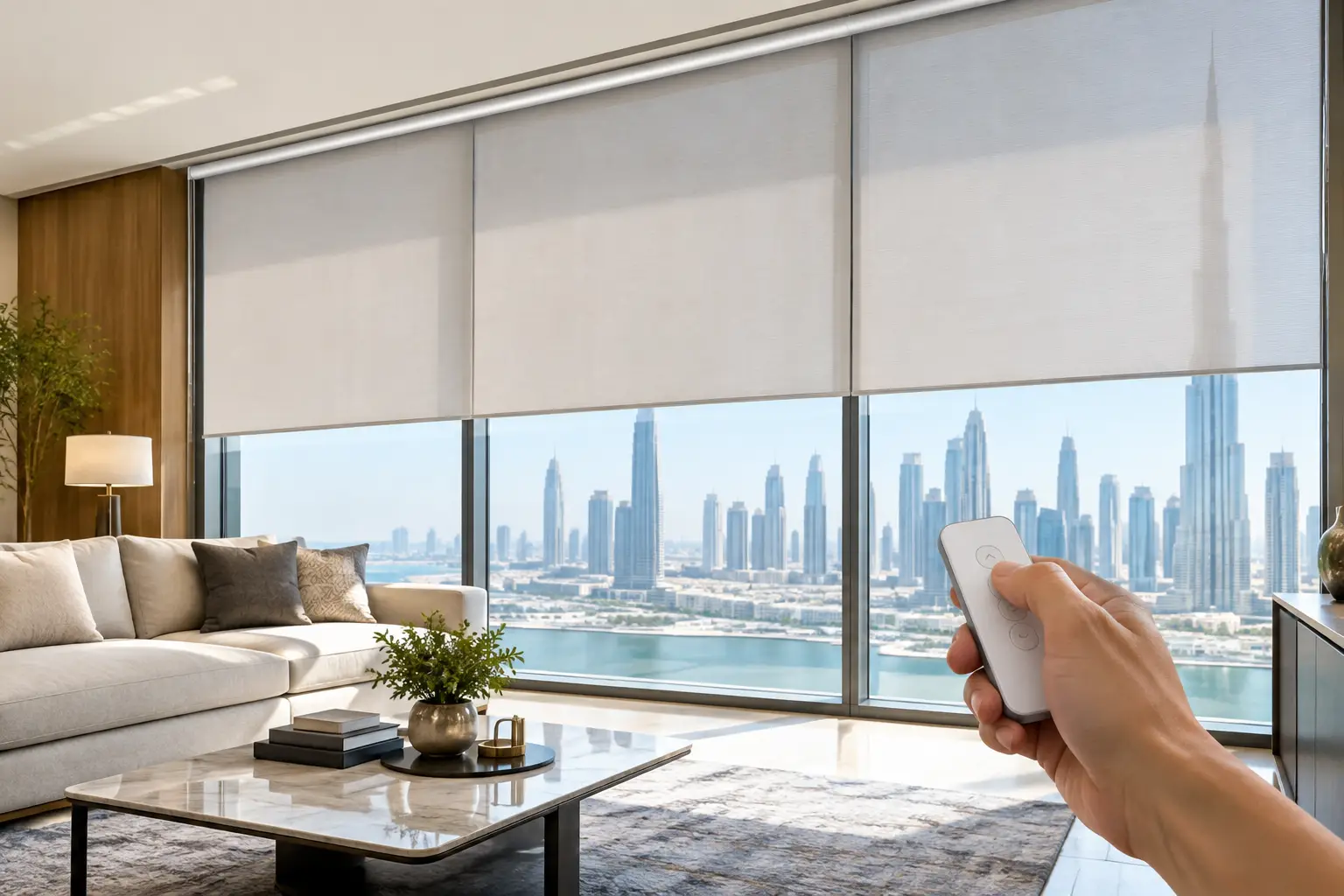
A west-facing living room can be beautiful at sunset and uncomfortable five minutes later. Glare catches the TV, the room heats up, and reaching across wide windows to adjust each blind becomes a daily chore. Motorized blinds with remote control solve that practical problem while giving your interior a cleaner, more considered finish.
For apartments, villas, offices, and hospitality spaces, automation is not simply an added luxury. It is a useful way to manage privacy, light, and comfort from a single point of control. The best result, however, depends on selecting the right blind type, motor system, fabric, and installation method for the room.
Why motorized blinds make sense
The immediate advantage is convenience. A handheld remote lets you raise, lower, or tilt blinds without moving furniture, reaching over a desk, or interrupting a meeting. This is especially valuable for tall windows, double-height spaces, sliding-door openings, and windows positioned behind sofas or beds.
The larger benefit is consistent light control. Instead of leaving blinds half-open because adjustment is inconvenient, you can set them exactly where you want them. In a bedroom, that may mean closing blackout blinds at night. In a home office, it may mean lowering sunscreen roller blinds enough to soften glare while preserving an outside view.
Motorization also supports a more polished design. There are no hanging pull cords to distract from the fabric or window frame, and the blind can move evenly across large openings. For homes with children or pets, removing loose operating cords is another sensible safety improvement.
In Dubai and across the UAE, the choice can also affect day-to-day temperature comfort. A well-selected solar screen or blackout fabric reduces harsh sunlight at the glass. It will not replace air conditioning or insulated glazing, but it can reduce direct solar glare and make a bright room easier to use throughout the day.
Choosing motorized blinds with remote control
A remote-controlled system is only as good as its fit with your windows and routine. Before choosing colors or fabrics, consider how the room is used, which direction the windows face, and whether privacy or daylight is the priority.
Start with the blind style
Roller blinds are a popular choice for motorization because their simple structure creates a neat, minimal look. They work well in living rooms, kitchens, offices, bedrooms, and large glazed areas. Blackout roller fabrics are suited to bedrooms, media rooms, schools, and spaces where light exclusion matters. Sunscreen fabrics are better where daytime visibility and glare reduction need to work together.
Roman blinds bring more softness and decorative character, making them a strong option for bedrooms, lounges, and boutique hospitality interiors. Vertical blinds can suit wide office windows and sliding openings, while motorized Venetian blinds offer adjustable light direction through tilting slats. Each system has different stacking, maintenance, and control characteristics, so the most attractive fabric is not always the most suitable operating solution.
For a living room with strong afternoon sun, a sunscreen roller blind may be the practical starting point. For a bedroom that needs darkness and privacy, blackout roller blinds or blackout-lined Roman blinds are usually more appropriate. Some homes benefit from two layers: a sheer or sunscreen blind for daytime and a blackout treatment for night.
Decide how you want to control them
A remote control is straightforward and reliable. It can operate one blind, a group of blinds, or multiple zones, depending on the selected motor and control setup. A multi-channel remote is particularly useful where a room has several windows. You can control all blinds together for a fast privacy setting, then adjust individual windows when needed.
Wall switches offer a fixed control point and are useful near room entrances or beside a bed. Smart-home integration can add app control, voice commands, timers, and scenes. For example, a morning scene can raise bedroom blinds gradually, while an evening scene lowers living room blinds before direct sunlight becomes uncomfortable.
There is a trade-off. A remote-only setup is often simpler and more cost-effective. Smart integration offers more flexibility but requires compatible equipment, stable configuration, and sometimes an electrician or automation specialist. If you are renovating a home, it is worth discussing control options before painting and ceiling work are complete.
Choose the power source carefully
Motorized blind systems are generally powered by hardwired electricity, rechargeable batteries, or replaceable batteries. Hardwired motors are a strong choice for new builds, full renovations, and large installations because they avoid routine charging. They need planned cabling, which is easiest before final finishes are installed.
Battery-powered motors can be an excellent option for completed homes where opening walls is not desirable. They keep installation cleaner and faster, although charging intervals depend on blind size, fabric weight, use frequency, and motor capacity. Very large or frequently operated blinds may be better suited to hardwired power.
A site visit helps identify the practical option. The installer can check access to power, blind width and drop, ceiling details, nearby furniture, and whether there is space for the motor and brackets to be installed neatly.
Fabric affects comfort as much as the motor
A motor can make any blind easier to operate, but the fabric determines how the room feels when the blind is down. This is where many off-the-shelf purchases fall short. A fabric that looks good in a showroom may create too much glare at home, block more daylight than expected, or provide insufficient privacy at night.
Sunscreen fabric is commonly selected for living areas and offices because it filters sunlight while maintaining a degree of outward visibility. Its openness level matters. A more open weave allows a clearer view but gives less daytime shading and privacy. A tighter weave provides stronger light control but reduces visibility.
Blackout fabric is designed for substantial light blocking, though small light gaps can still appear around the sides or top of a blind depending on the fitting. If near-total darkness is the goal, accurate measurements and the right mounting position matter as much as the fabric itself. For bedrooms, a recess fit may look tidy, while an outside mount with adequate overlap can reduce side light more effectively.
Color also has a role. Lighter shades often keep a room feeling open and can complement minimal interiors. Darker tones create contrast and may be preferred for media rooms or dramatic design schemes. Your choice should balance decor, glare control, and the view from inside the room.
Why made-to-measure installation matters
Motorized blinds need precise sizing. A blind that is even slightly mismeasured may leave unwanted light gaps, brush against a handle, sit unevenly, or fail to cover the glass as intended. With wide windows, the weight of the fabric and the load on the motor must also be assessed correctly.
Professional measurement accounts for window recess depth, obstructions, moldings, door handles, ceiling bulkheads, and the opening direction of nearby doors. It also establishes whether the blind should sit inside the recess, above the window, or from the ceiling for a more dramatic full-height appearance.
At Dubai Drapes Studio, a free appointment allows our team to bring suitable samples, assess your windows, explain control options, and provide a quick quotation based on the actual installation conditions. This avoids the uncertainty of ordering a standard-size product and hoping it works once it arrives.
Questions worth asking before you order
Ask whether the motor is rated for the blind size and fabric weight, how many channels the remote includes, and whether the system can be expanded later. You should also confirm the expected battery charging method if you choose a wire-free motor, the warranty coverage, and who will handle programming and final testing.
For smart-home projects, ask whether the chosen motor is compatible with your existing automation platform. Compatibility should be confirmed before purchase, not assumed from a general product description. If several rooms are involved, plan control zones early so daily operation stays simple rather than confusing.
Finally, think about maintenance. Most blind fabrics need only gentle dusting or vacuuming with a soft brush attachment. Avoid harsh cleaning products around the motor and control components. A properly fitted system should run smoothly, but unusual noise, uneven travel, or slow movement should be checked early before it affects the fabric or brackets.
The right motorized blind should feel effortless after installation. It should soften the sun when you need it, protect privacy when the day ends, and suit the room so naturally that reaching for the remote becomes one less thing to think about. Book a free appointment to see fabrics, compare control options, and have a system planned around your windows rather than a standard box size.