

Dubai Drapes Studio, the Best quality Cubicle Privacy Curtains in Dubai, with and without mesh, permanent inherent anti-bacterial and fire retardant, meeting the Standards of UAE Health Authorities.
A curtain around a patient bed, treatment bay, changing area, or shared workspace has one immediate job: give people a clear sense of personal space. The right cubicle privacy curtains do that without making the room feel cramped, difficult to clean, or poorly planned. The wrong system can snag, gap at the edges, hang unevenly, or become a constant maintenance issue.
For healthcare facilities hospitals and clinics, schools, gyms, spas, offices, and hospitality projects, privacy curtains should be selected as part of the room’s working layout, not as an afterthought. Fabric performance, track shape, drop length, cleaning requirements, and installation details all affect how well the finished system serves the people using the space.
Where Cubicle Privacy Curtains Make a Difference
Cubicle curtains are most familiar in hospitals, clinics, and medical centers, where they separate patient beds and treatment areas while allowing staff to move quickly around the room. They are equally useful in physiotherapy centers, dialysis facilities, maternity wards, recovery rooms, and outpatient treatment spaces.
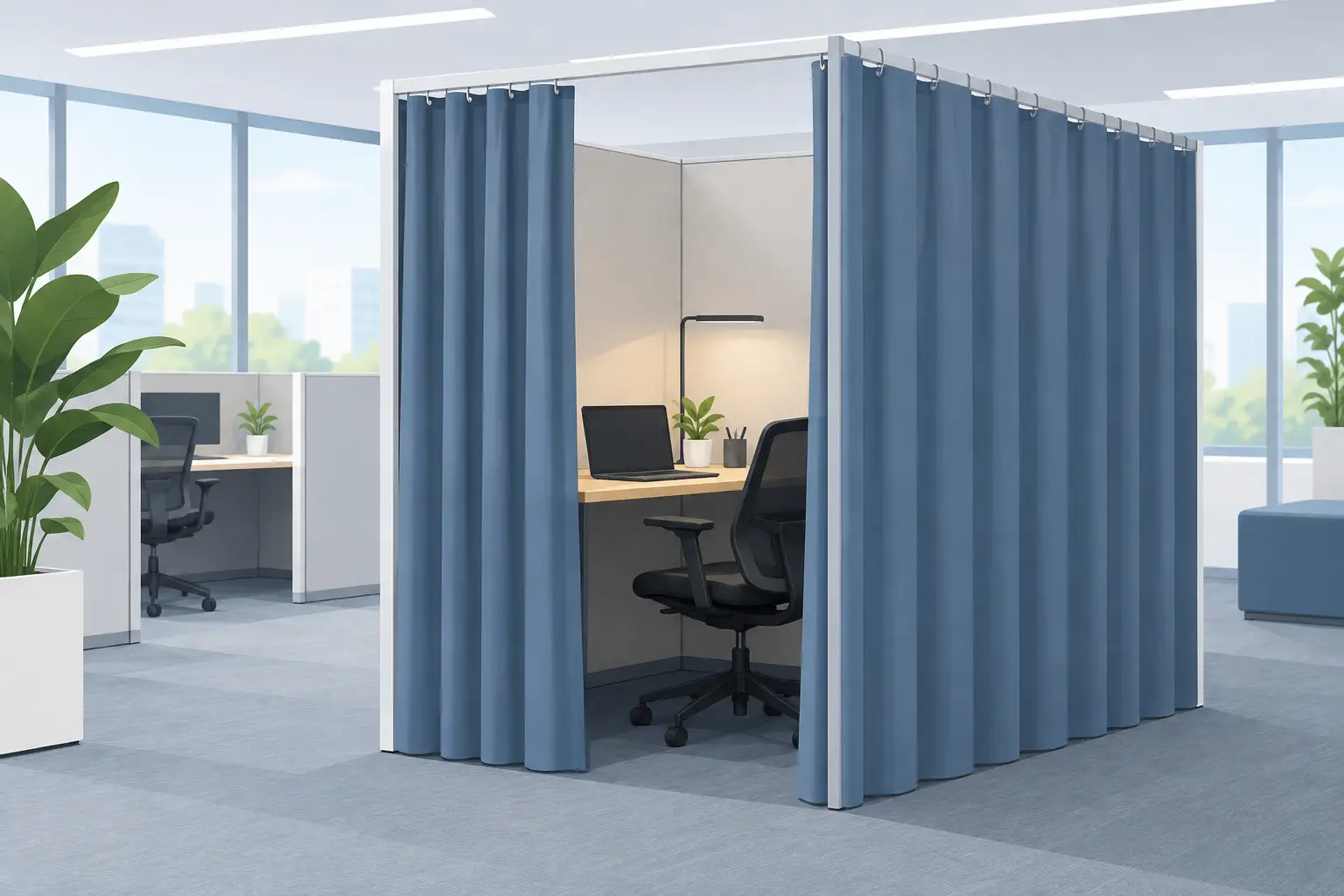
Outside healthcare, these curtains solve practical privacy issues in schools, nurseries, changing rooms, wellness centers, salons, staff rest areas, and temporary consultation zones. In an open-plan office, a carefully positioned curtain system can create a private area for nursing, first aid, confidential conversations, or focused work without the expense and disruption of building permanent partitions.
The benefit is not only visual separation. A well-designed curtain layout can soften acoustics, conceal equipment, direct movement through a room, and make a shared environment feel calmer. That said, fabric curtains do not provide complete soundproofing or the security of a solid wall. If confidentiality requires acoustic isolation or lockable separation, a different partition solution may be more appropriate.
Start With How the Space Will Be Used
Before choosing a color or pattern, consider what happens in the room every day. Does the curtain open and close dozens of times per shift? Will it need to be removed regularly for laundering? Does staff need fast access to a bed or treatment chair from more than one side? Are ceilings high, angled, or filled with services such as lighting, sprinklers, and air-conditioning grilles?
These details determine the most suitable track and curtain configuration. A straight track may suit a simple wall-to-wall division. A U-shaped or L-shaped layout is often better for bed bays, examination areas, and changing spaces because it provides coverage on multiple sides. Ceiling-mounted tracks usually create a cleaner, more complete result than wall-mounted rods, particularly where floor space is limited.
A site visit is valuable because plans do not always show obstructions, ceiling conditions, or access requirements clearly. Accurate measurements also prevent common problems such as curtains dragging on the floor, leaving privacy gaps, or bunching excessively when stacked open.
Choose the Right Curtain Drop and Fullness
Most privacy curtains are specified to finish just above the floor. This helps reduce dragging, collects less dust, and allows easier cleaning while still providing proper coverage. In healthcare and institutional settings, the required clearance may depend on the facility’s operating procedures and local regulations.
Curtain fullness matters too. A flat panel may look sparse and leave openings when pulled closed. Additional fabric width creates better coverage and a more professional appearance, but too much fullness can make the curtain bulky on the track. The goal is a curtain that closes comfortably, stacks neatly, and gives users privacy without obstructing the room.
Fabric Selection Is About Performance First
A decorative fabric may look appealing in a sample book, but cubicle curtain fabric must stand up to its intended environment. In busy clinical areas, priorities often include durability, washability, stain resistance, and compatibility with infection-control procedures. Some projects require flame-retardant fabrics or fabrics with specific performance documentation. Requirements vary by building type and local authority, so specifications should be checked before production begins.
For a hospital or medical clinic, antimicrobial or treated fabrics may be considered as part of a broader hygiene strategy. They are not a substitute for regular cleaning, proper laundering, or facility infection-control practices. The best choice depends on the maintenance routine, the level of use, and the standards required for the project.
For spas, salons, boutique fitness studios, and hospitality spaces, appearance may carry more weight. Textured fabrics, soft neutral tones, subtle patterns, and coordinated track finishes can make functional separation feel intentional. Even then, choose a material that can tolerate frequent handling and the conditions of the room. Humid areas, for example, may need materials selected specifically for moisture exposure and easy upkeep.
Track Systems Should Support Daily Movement
A privacy curtain is only as reliable as its track. Smooth-running carriers, strong brackets, well-finished bends, and secure end stops make a noticeable difference to daily use. Staff should be able to open the curtain with one hand and close it without pulling hard enough to strain the fabric or fittings.Privacy curtain Tracks
Ceiling tracks can be recessed for a more integrated finish or surface-mounted where ceiling construction makes recessing impractical. In some projects, suspended tracks are needed to clear ceiling features or achieve the right drop. Curved tracks are especially useful around beds and treatment stations, but they require accurate fabrication and careful installation to keep the curtain running freely.
Do not overlook access points. A system may need breakaway sections, overlap panels, or openings positioned around equipment and doors. In clinical settings, emergency access and staff workflow should guide the design. In commercial interiors, the curtain stack should be placed where it does not block a walkway, window, storage area, or emergency route.
Design for Cleaning, Replacement, and Long-Term Use
Privacy curtain systems are easier to manage when maintenance is planned from the start. Removable curtains with practical hooks or carriers can reduce the effort needed for laundering or replacement. A spare set of matching curtains can also help facilities maintain privacy while one set is being cleaned.
Color and pattern deserve practical consideration. Very light fabrics can make a room feel fresh, but they may show marks more quickly in high-contact areas. Dark colors can conceal wear but may make a small treatment space feel enclosed. Mid-tone shades, small-scale patterns, and coordinated neutral palettes often offer a balanced solution.
For multi-room facilities, standardizing fabrics and track components can simplify future replacements. It also creates a consistent visual identity across wards, treatment rooms, changing areas, and staff spaces. A custom project does not have to mean every room is different. Often, the smartest specification is one tailored system that can be repeated reliably.
Why Made-to-Measure Installation Matters
Off-the-shelf curtains may appear to be a quick answer, but they rarely account for exact track lengths, ceiling heights, bends, obstructions, or the desired level of coverage. Small fitting errors are obvious in a privacy system. A short panel can leave a gap. An overly long panel can drag. An incorrectly spaced track can interfere with doors, equipment, or ceiling services.
Made-to-measure cubicle privacy curtains allow the fabric, heading style, track layout, and finished drop to be matched to the actual site. This is particularly useful for fit-out firms, designers, and facility managers working to a defined plan, as well as homeowners creating flexible privacy in shared rooms or multipurpose spaces.
Dubai Drapes Studio manages the process from site measurement and fabric selection through custom tailoring and professional installation. That single point of responsibility helps keep the finished system aligned with the room layout, operating needs, and design direction.
A Better Starting Point for Your Project
Bring a room plan, photos, or even a simple description of how the area is used to your consultation. The useful questions are straightforward: who needs privacy, how often will the curtains move, what cleaning routine is required, and what must remain accessible when the curtains are closed?
Book a free appointment to discuss the space, review suitable fabrics and track options, and arrange precise measurement. A privacy curtain should quietly do its job every day – giving people comfort, dignity, and a well-finished environment without getting in the way.